The brain is not an enormous whiteboard
One of the central ideas from cognitive science is that our working memory is pretty limited.
We demonstrated this with a slightly bizarre collection of objects—card, keys, pencil, tomato, charger, stuffed bird-bear—and discovered that there really isn't that much room at the inn.
Working memory is where we temporarily hold and manipulate information. If too much arrives at once, things begin falling out.
Long-term memory, however, is a different beast.
The challenge for teaching is therefore not simply getting information in front of children, but helping knowledge move from something fragile and temporary towards something more stable and retrievable.
This is where repetition, revisiting and retrieval come in. If children encounter something once and never return to it, there is a pretty decent chance it will disappear.
Conceptual diagram
A narrow workbench and a much larger store
New material has to be handled in limited working memory before it can be connected to organised knowledge in long-term memory.
Knowledge needs somewhere to go
Eventually, pieces of knowledge begin knitting themselves together into schemas: organised networks that help us interpret new information.
If I know almost nothing about Tudor England, every new Tudor fact is floating around relatively alone.
Once I understand Henry VIII, religious change, monarchy, succession and the wider historical period, new information has somewhere to go.
It has hooks.
The danger of assumed knowledge
This also means we need to think carefully about what children already know—or, perhaps more dangerously, what we assume they already know.
Existing schemas can contain useful prior knowledge, but they can also contain gaps and misconceptions. If those foundations are shaky, new material may be misunderstood or have nothing secure to connect with.
So before building another floor, it is probably worth checking what state the foundations are actually in.
That might mean retrieving earlier learning, asking diagnostic questions, revisiting important vocabulary or giving children enough context for the new idea to make sense.
The cunning schema does not simply appear. It is built, revisited, checked and gradually made more useful.
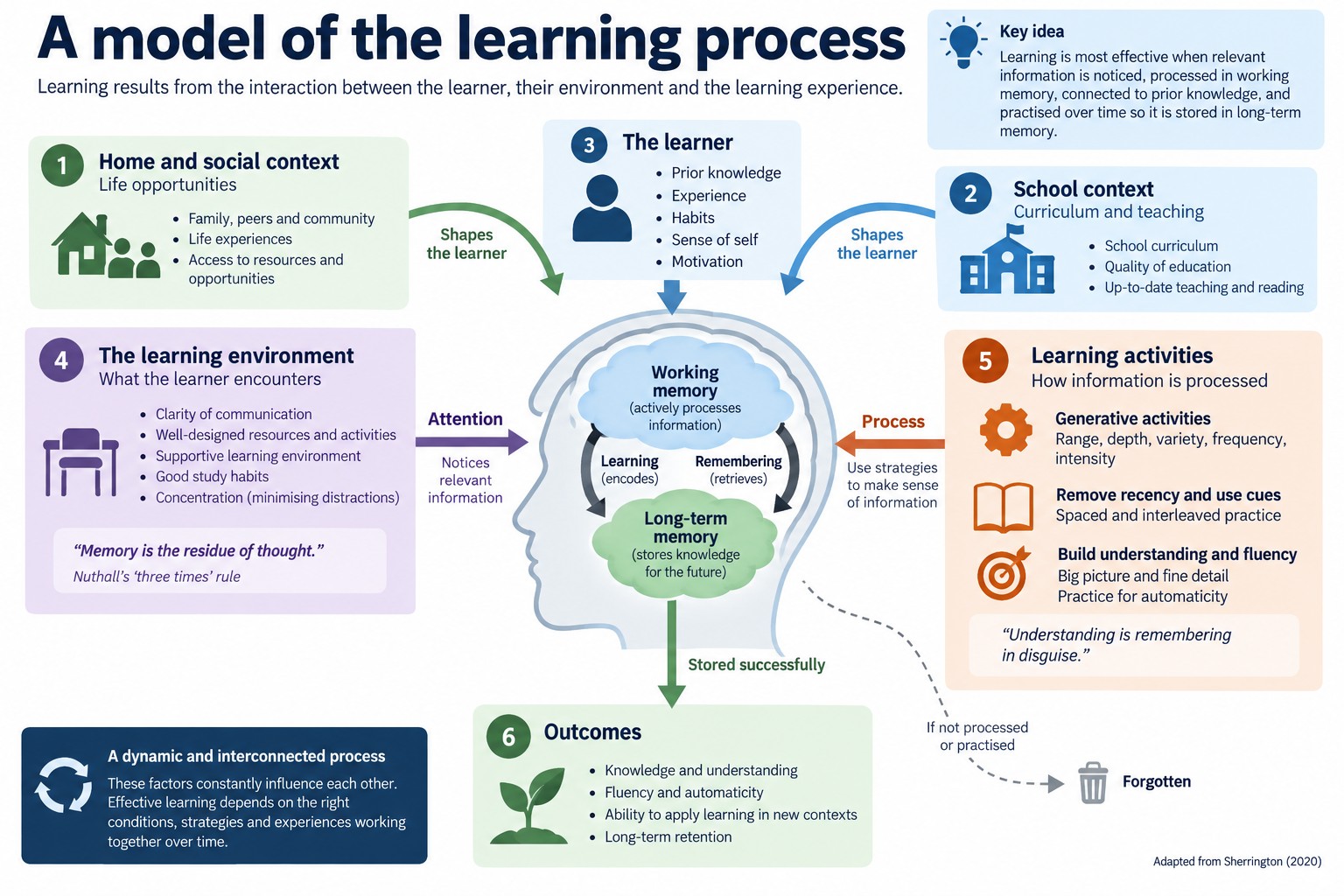
Interactive model
Explore the learning process
Select a numbered area to isolate its main ideas and see how it contributes to learning.
Read a complete text summary of the model
The model presents learning as a dynamic interaction between six areas. Home and social context—including family, peers, life experiences and access to opportunities—shapes the learner. School context, including curriculum and teaching quality, also shapes the learner. The learner brings prior knowledge, experience, habits, identity and motivation. A clear and supportive learning environment helps direct attention towards relevant information. Learning activities then help pupils process ideas through varied and spaced practice, cues, and work towards understanding and fluency. Information is encoded into long-term memory and later retrieved into working memory. When this process succeeds, outcomes include knowledge, automaticity, application in new contexts and long-term retention; information that is not processed or practised may be forgotten.
What this changes for me
The practical implication is not that every lesson needs more activities. It is that new learning needs careful attention, manageable processing, connections with prior knowledge and opportunities to be retrieved again.
So, rather than merely asking whether I have explained something, I need to ask whether pupils had the knowledge and mental space to make sense of it—and when they will be asked to use it again.