Our EYFS session was a bit of a whistle-stop tour, but I came away thinking that there is something quite powerful about looking at education from the beginning again.
One of the big names was Lev Vygotsky, particularly his idea of the zone of proximal development: roughly, the space between what a child can currently do independently and what they can achieve with appropriate support.
That fits nicely with the current Development Matters guidance. Children need opportunities to explore independently, but adults also scaffold learning by giving them just enough support to achieve something they could not yet manage alone. Early-years pedagogy therefore involves a mixture of play, modelling, guided learning and direct teaching rather than treating these approaches as opposites.
That balance was probably my biggest takeaway.
The setting described in our session gave large parts of the day over to child-initiated play, punctuated by shorter periods of adult-led learning. The adult’s role during play was not simply to stand back and observe. They might organise an interesting environment, enter into children’s play and sensitively extend what was happening.
The evidence around play is more nuanced than simply saying that play is always best: the EEF finds promising benefits for play-based learning, but also describes the evidence base as limited and distinguishes between free play, guided play and more adult-directed activities.
We also looked at Blank’s Levels of Questioning, which I want to remember. These move broadly from:
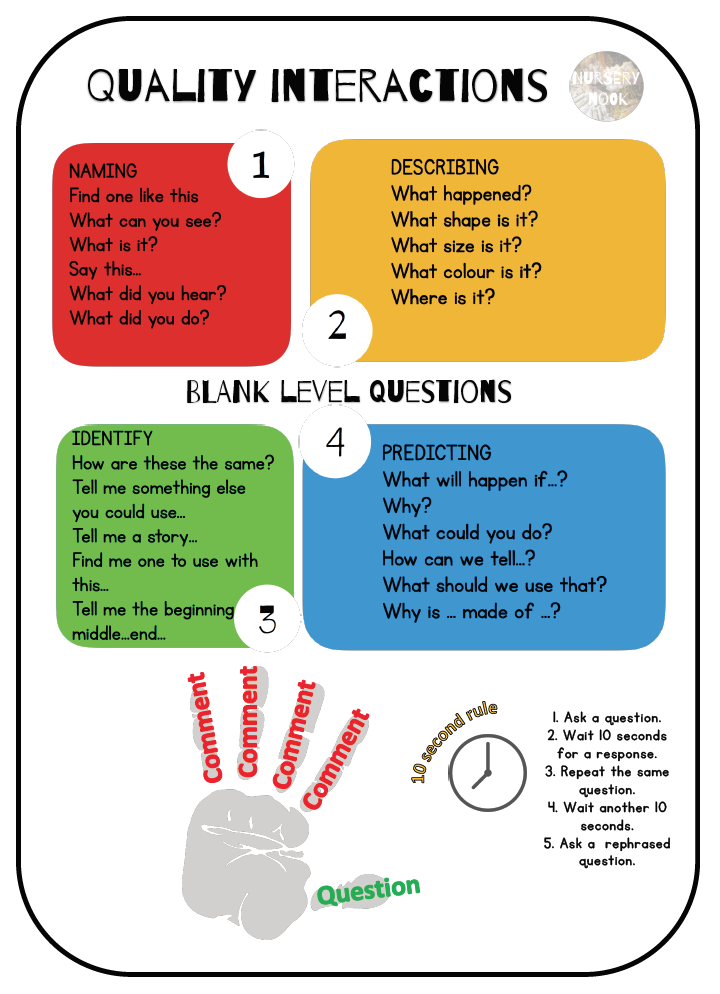
The useful bit is not racing towards the hardest question. If a child is struggling, simplify the language and move back to a level they can access.
Perhaps most interestingly, the session made me wonder how much of this remains relevant long after Reception.
If a Year 6 pupil is struggling to write comfortably, for example, perhaps the answer is not always another reminder about their pencil grip. EYFS places much greater emphasis on the foundations beneath fine-motor control: movement, coordination, strength and repeated opportunities to manipulate objects and tools.
Likewise, perhaps maths does not always need to begin with numbers on a page. Fractions, measurement, ratio or data could sometimes grow out of something pupils have actually built, measured, grown or investigated.
That may be the thing I want to carry from EYFS into Year 6: